Term Life vs. Permanent Life Insurance: What Is the Difference?
Choosing a life insurance policy can be an important financial decision, especially when you want to protect your family and provide financial security for the people who depend on you. However, when you begin comparing life insurance options, you will quickly discover that there are different types of policies available.
Two of the most common categories are term life insurance and permanent life insurance.
Both types are designed to provide a death benefit to your beneficiaries if you die while covered and the policy requirements are met. However, they differ significantly in how long coverage lasts, how premiums work, whether the policy may build cash value, and how much the coverage may cost.
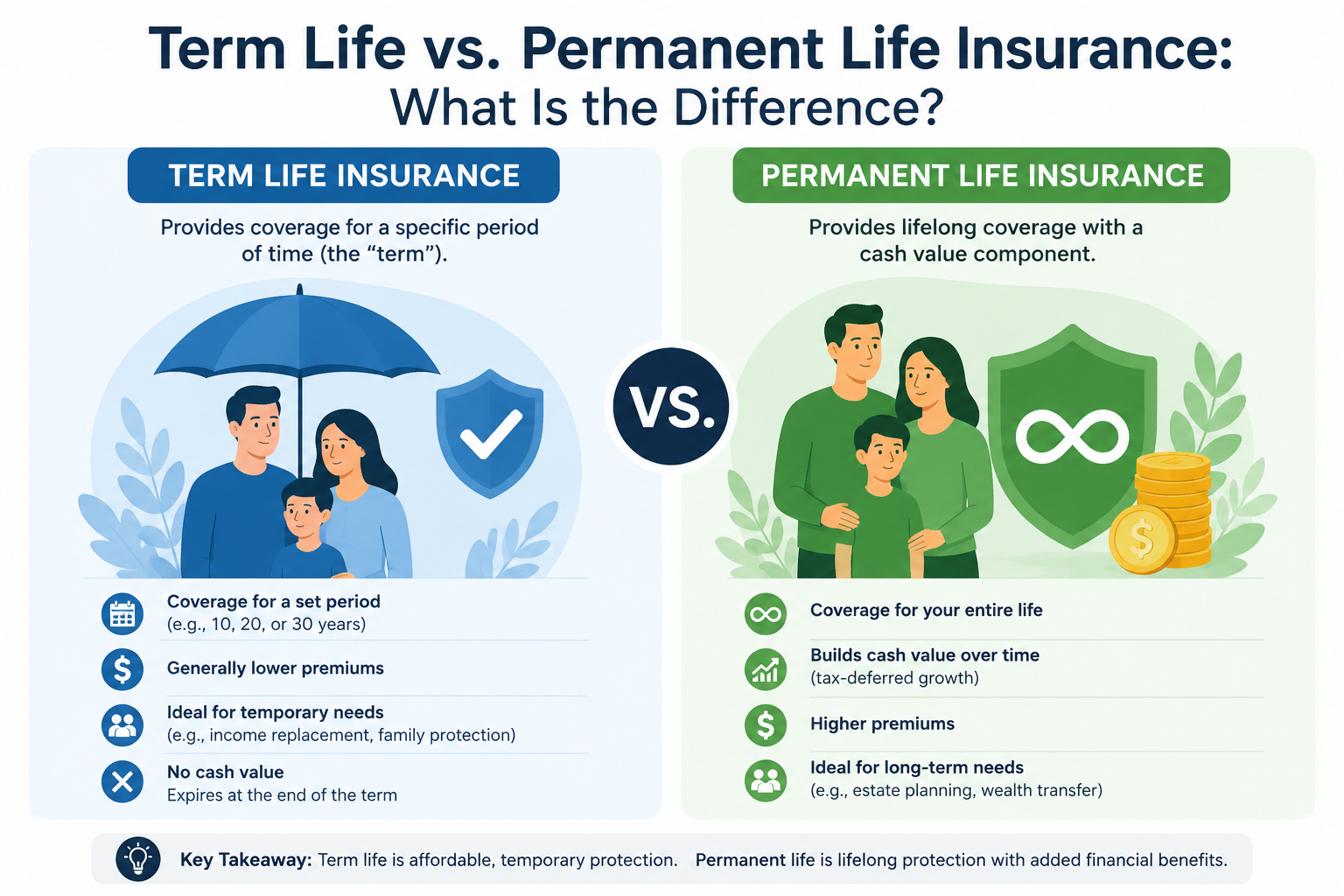
Term life insurance generally provides protection for a specific period, while permanent life insurance is designed to provide long-term coverage as long as the policy remains active and its requirements are met.
Understanding the differences between these two options can help you make a more informed decision about which type of coverage may fit your financial situation.
What Is Term Life Insurance?
Term life insurance provides coverage for a specific period of time, known as the policy term.
Common term lengths include:
- 10 years
- 20 years
- 30 years
For example, a person may purchase a 20-year term life insurance policy. If that person dies during the 20-year coverage period and the policy conditions are satisfied, the insurance company may pay the death benefit to the named beneficiaries.
However, if the policy term ends while the insured person is still alive, the coverage may expire unless the policy includes options for renewal, conversion, or extension.
Term life insurance is often considered one of the simpler forms of life insurance because its main purpose is straightforward: providing financial protection for a specific period.
How Does Term Life Insurance Work?
The process usually begins with selecting the amount of coverage and the length of the policy.
For example, someone might decide they need life insurance coverage for the next 20 years because they have young children and a mortgage.
They may then apply for a term life insurance policy with a specific death benefit.
The insurance company reviews the application and determines whether to offer coverage. If the policy is approved, the policyholder pays the required premiums.
As long as the policy remains active, the insured person is covered during the selected term.
If the insured person dies during that period, the beneficiaries may file a claim. If the claim is approved according to the policy terms, the insurer pays the death benefit.
If the insured person is still alive when the term ends, the policy may expire without paying a death benefit.
Advantages of Term Life Insurance
Term life insurance can offer several potential advantages.
1. Lower Initial Premiums
For a similar death benefit amount, term life insurance often has lower initial premiums than permanent life insurance.
This can make term coverage attractive for people who want substantial protection but have a limited insurance budget.
However, actual premiums depend on many factors, including age, health-related underwriting information, policy length, coverage amount, and the insurer.
2. Simple and Easy to Understand
Term life insurance is generally easier for beginners to understand.
You choose:
- A coverage amount
- A policy term
- A beneficiary
- A payment schedule
The policy then provides coverage during the agreed period, subject to its terms and conditions.
3. Useful for Temporary Financial Responsibilities
Many financial responsibilities have a specific time frame.
For example:
- Children eventually become financially independent.
- A mortgage may eventually be paid off.
- Business loans may have a limited repayment period.
- Other debts may decrease over time.
Term life insurance may be useful when you primarily need protection during these years.
4. Higher Coverage May Be More Affordable
Because term insurance is generally focused on temporary protection, some people may be able to purchase a larger death benefit for a lower initial premium compared with certain permanent policies.
This can be useful for families that need significant financial protection during a specific period.
Disadvantages of Term Life Insurance
Term life insurance also has limitations.
1. Coverage Does Not Necessarily Last Forever
The main disadvantage is that the policy has a specific expiration date.
If the policy term ends while the insured person is still alive, the coverage may end unless renewal or another option is available.
2. Renewing Coverage May Cost More
Depending on the policy, renewing coverage after the original term may result in higher premiums.
The cost may increase because the insured person is older and other underwriting factors may apply.
3. Traditional Term Life Usually Does Not Build Cash Value
Most traditional term life insurance policies do not include a cash value component.
This means the primary purpose of the premiums is to maintain insurance protection during the policy term.
What Is Permanent Life Insurance?
Permanent life insurance is designed to provide long-term coverage rather than coverage for a fixed number of years.
As long as the policy remains active and required premiums or other policy requirements are met, the coverage may continue for the insured person’s lifetime.
Permanent life insurance includes several different types of policies, including:
- Whole life insurance
- Universal life insurance
- Variable life insurance
These policies can have different structures, benefits, costs, and risks.
One major feature of some permanent life insurance policies is the potential to build cash value.
How Does Permanent Life Insurance Work?
Like term life insurance, permanent life insurance begins with an application and underwriting process.
After the policy is issued, the policyholder makes premium payments according to the policy terms.
Part of the policy’s structure may provide long-term life insurance protection, while some policies may also build cash value.
The way premiums and cash value work depends on the specific policy.
For example, some policies may have more predictable premium structures, while others may offer flexibility but require careful management.
As long as the policy remains in force and its requirements are met, permanent life insurance is designed to continue providing coverage.
When the insured person dies, the beneficiaries may receive the death benefit according to the policy terms.
Types of Permanent Life Insurance
Whole Life Insurance
Whole life insurance is a type of permanent life insurance designed to provide long-term coverage.
It may include:
- A death benefit
- Premium requirements
- Cash value accumulation
Some whole life policies have relatively predictable premium structures, but the exact features depend on the contract.
Whole life insurance can be more expensive than term life insurance, particularly when comparing similar death benefit amounts.
Universal Life Insurance
Universal life insurance is another form of permanent life insurance.
It may provide more flexibility regarding premium payments or death benefit structures, depending on the policy.
However, universal life insurance can also be more complex. Policy performance may depend on factors such as interest rates, policy charges, and the amount of premiums paid.
Policyholders should understand how changes in these factors could affect the long-term performance of the policy.
Variable Life Insurance
Variable life insurance may allow the policyholder to allocate cash value among available investment options.
Because the value can be connected to investment performance, the cash value and potentially other policy values may increase or decrease.
Variable life insurance can involve investment risk and may be more suitable for people who fully understand those risks and the policy structure.
What Is Cash Value?
Cash value is a feature found in many permanent life insurance policies.
Over time, a portion of the policy’s value may accumulate according to the policy terms.
The way cash value grows depends on the type of policy.
Some policies may offer guaranteed values or interest components, while others may depend partly on market or investment performance.
Depending on the policy, the policyholder may have options to:
- Withdraw money
- Borrow against the cash value
- Use available value to support certain premium payments
However, accessing cash value can have important consequences.
Withdrawals or loans may:
- Reduce the available cash value
- Reduce the death benefit
- Affect the policy’s future performance
- Create financial or tax consequences in some situations
- Increase the risk that the policy could lapse if not managed properly
For these reasons, permanent life insurance policies should be reviewed carefully before using their cash value.
Term Life vs. Permanent Life Insurance: The Main Differences
The biggest difference between term and permanent life insurance is the duration of coverage.
Coverage Duration
Term life insurance provides coverage for a specific period, such as 10, 20, or 30 years.
Permanent life insurance is designed to provide long-term coverage as long as the policy remains active and required conditions are met.
Cost
Term life insurance often has lower initial premiums.
Permanent life insurance may cost more because it is designed for long-term coverage and may include additional features such as cash value.
However, actual costs vary based on the policyholder, insurer, coverage amount, policy type, and other factors.
Cash Value
Traditional term life insurance generally does not build cash value.
Many permanent life insurance policies include a cash value component, although the way it works varies between products.
Complexity
Term life insurance is generally simpler.
Permanent life insurance can be more complex because of cash value, policy charges, investment components, interest rates, premium flexibility, and other features.
Policy Purpose
Term life insurance is often considered for temporary financial needs.
Permanent life insurance may be considered when long-term coverage is a priority.
Quick Comparison Between Term and Permanent Life Insurance
Term Life Insurance
- Coverage lasts for a specific period.
- Often has lower initial premiums.
- Generally does not include cash value.
- Usually easier to understand.
- May be suitable for temporary financial responsibilities.
- Coverage may expire when the term ends.
Permanent Life Insurance
- Designed for long-term coverage.
- May have higher premiums.
- Often includes a cash value component.
- Can have more complex features.
- May be suitable for long-term financial planning.
- Requires careful understanding of policy costs and conditions.
When Might Term Life Insurance Be a Good Choice?
Term life insurance may be worth considering if your primary goal is to provide financial protection during a specific period.
For example, you might consider term coverage if you:
- Have young children
- Have a mortgage
- Have significant temporary financial responsibilities
- Want coverage during your working years
- Need a larger death benefit while managing a limited budget
Imagine a parent with two young children and a 25-year mortgage. Their main concern may be ensuring that their family has financial protection until the children become independent and the mortgage is paid.
A term policy covering that period may align with those specific financial responsibilities.
The right choice, however, depends on the person’s complete financial situation.
When Might Permanent Life Insurance Be a Good Choice?
Permanent life insurance may be considered by people who want long-term coverage and are comfortable with the higher costs and additional policy complexity.
It may be relevant for individuals who:
- Want coverage designed to last for their lifetime
- Have long-term financial responsibilities
- Are interested in policies with cash value features
- Want to include life insurance in a broader financial or estate plan
However, permanent life insurance is not automatically the better choice simply because it can last longer.
The higher costs and policy structure should be carefully considered.
How to Decide Between Term and Permanent Life Insurance
Choosing between these two options requires looking at your personal financial situation.
Consider the following questions.
How Long Do You Need Coverage?
If your main financial responsibilities are expected to decrease over time, term life insurance may be worth considering.
If you want coverage designed for the long term, permanent insurance may be more relevant.
What Is Your Budget?
Insurance premiums must fit realistically within your financial plan.
A policy that is difficult to maintain may not be the best choice for your circumstances.
Compare the costs of different coverage options before making a decision.
Do You Need Cash Value?
If your primary goal is simply life insurance protection, cash value may not be necessary.
If you are interested in permanent insurance features, carefully understand how the cash value works, including potential costs and risks.
What Other Financial Resources Do You Have?
Savings, investments, retirement accounts, and other insurance coverage can affect your overall financial planning.
Life insurance should generally be considered as part of your broader financial situation rather than in isolation.
Can You Have Both Term and Permanent Life Insurance?
In some situations, a person may own both term and permanent life insurance policies.
For example, someone may use permanent coverage for a long-term need while purchasing term insurance to provide additional protection during years of higher financial responsibility.
Whether this approach makes sense depends on individual circumstances, budget, insurance needs, and available options.
Having multiple policies is not automatically necessary, but it may be considered in certain financial situations.
Common Mistakes to Avoid
Choosing Based Only on Price
The cheapest policy is not always the best policy.
Consider the coverage amount, duration, policy conditions, financial stability of the insurer, and whether the policy fits your needs.
Buying More Complexity Than You Need
Permanent life insurance can have valuable features, but not everyone needs those features.
If your main goal is straightforward coverage for a limited period, a simpler policy may be easier to understand and manage.
Ignoring Long-Term Premium Costs
Before buying a policy, understand how premiums work over time.
Ask whether they are guaranteed, level for a specific period, flexible, or subject to change.
Not Reviewing Policy Documents
Life insurance contracts contain important information about coverage, exclusions, limitations, premiums, and other requirements.
Always read and understand the policy before purchasing it.
Failing to Review Coverage Over Time
Your financial needs can change after marriage, having children, purchasing property, changing jobs, or paying off debts.
Reviewing your coverage periodically can help ensure that it still matches your circumstances.
Frequently Asked Questions
Is Term Life Insurance Cheaper Than Permanent Life Insurance?
Term life insurance often has lower initial premiums for a similar death benefit, but actual prices depend on the individual and policy.
Does Term Life Insurance Build Cash Value?
Traditional term life insurance generally does not build cash value.
Does Permanent Life Insurance Last Forever?
Permanent life insurance is designed to provide long-term coverage, often for life, as long as the policy remains active and all required conditions are met.
Can I Convert Term Life Insurance Into Permanent Life Insurance?
Some term life insurance policies offer conversion options. The availability, deadlines, and conditions depend on the specific policy.
Which Type of Life Insurance Is Best?
There is no single policy that is best for everyone.
Term life insurance may be suitable for people who need affordable coverage for a specific period. Permanent life insurance may be suitable for people who want long-term coverage and additional policy features.
The right choice depends on your financial goals, budget, responsibilities, and personal circumstances.
Final Thoughts
Term life insurance and permanent life insurance both provide valuable forms of financial protection, but they are designed for different needs.
Term life insurance provides coverage for a specific period and is often simpler and more affordable initially. It may be useful for people who want protection while raising children, paying off a mortgage, or managing other temporary financial responsibilities.
Permanent life insurance is designed for long-term coverage and may include features such as cash value. However, it can be more expensive and complex.
Before choosing between the two, consider how long you need coverage, how much you can comfortably afford, the financial needs of your family, and whether additional policy features are important to you.
There is no universal answer. The best life insurance policy is the one that aligns with your individual financial responsibilities and long-term goals.
By understanding the differences between term and permanent life insurance, you can compare your options more confidently and make a more informed decision about protecting the people who depend on you.