When Should You Review Your Life Insurance Policy?
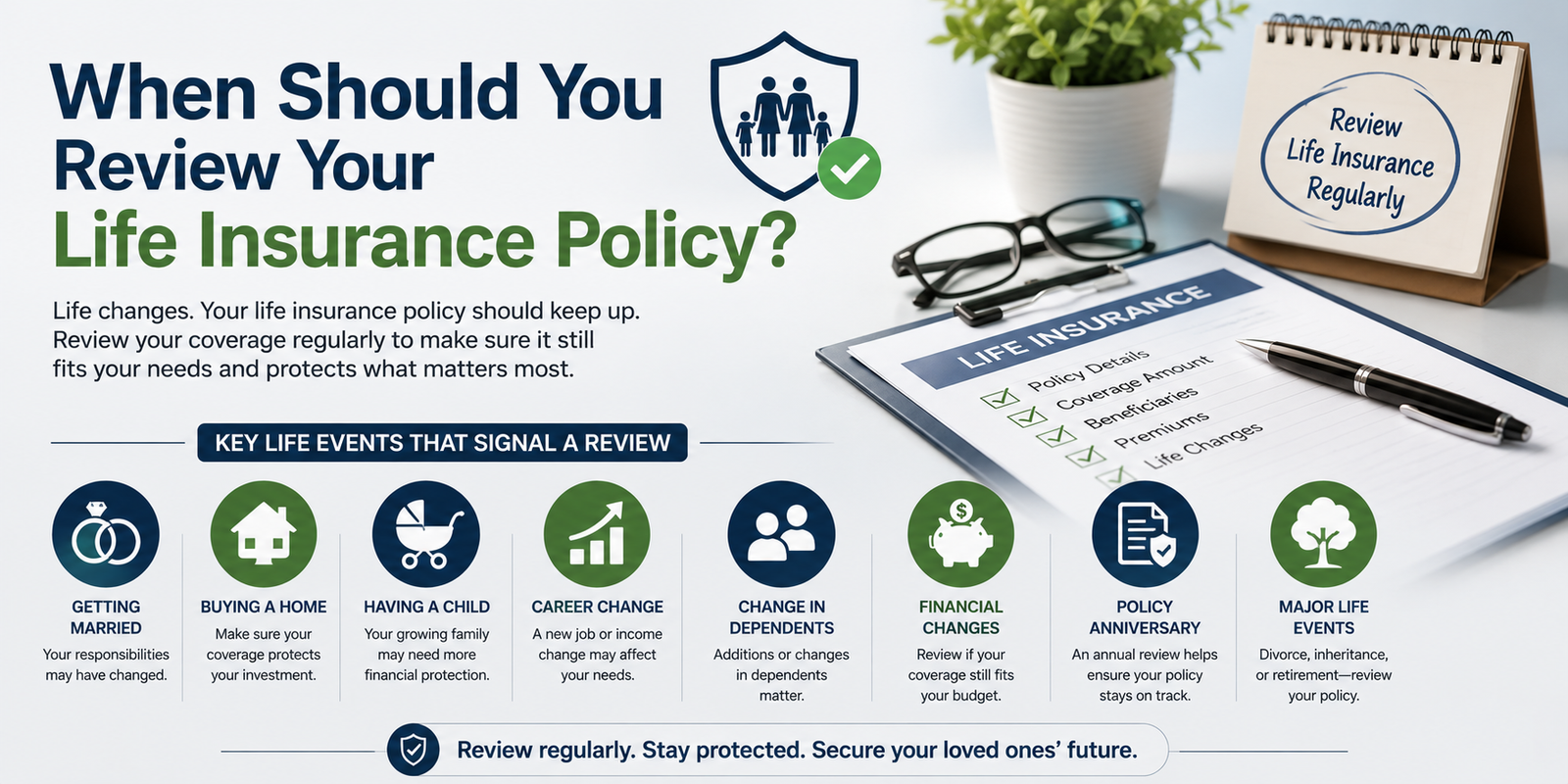
Buying a life insurance policy is an important step toward protecting your family’s financial future. However, purchasing a policy is not necessarily the end of the planning process. Your financial situation, family responsibilities, income, debts, and long-term goals can change over time. When they do, your life insurance coverage may need to change as well.
A policy that was appropriate several years ago may no longer provide the right amount of protection today. On the other hand, you may discover that you have more coverage than you currently need.
Regularly reviewing your life insurance policy can help ensure that your coverage, beneficiaries, premiums, and policy type continue to match your circumstances.
So, when should you review your life insurance policy?
A good starting point is to review it at least once a year and whenever you experience a major life or financial change.
Why Should You Review Your Life Insurance Policy?
Life insurance is designed to protect your loved ones financially if you die while the policy is active.
Your financial responsibilities can change considerably throughout your life. You might get married, have children, buy a home, change jobs, increase your income, pay off debt, or approach retirement.
Each of these changes can affect the amount of financial protection your family may need.
For example, a policy purchased when you were single may have been sufficient for your circumstances at the time. After marriage and the birth of children, however, your financial responsibilities could be much greater.
Regular policy reviews allow you to identify these changes and determine whether your coverage still fits your needs.
1. Review Your Policy After Getting Married
Marriage is one of the most important reasons to review life insurance.
Before marriage, you may have purchased coverage primarily to pay final expenses or protect a parent or another family member.
After marriage, your spouse may become financially dependent on your income.
Your spouse could rely on your income for:
- Mortgage payments
- Rent
- Utilities
- Transportation
- Household expenses
- Retirement savings
- Debt payments
- Other long-term financial goals
After getting married, review your coverage amount and beneficiary designations.
You may need to update your spouse as a beneficiary or consider whether the existing coverage is sufficient for your new household.
2. Review Your Policy When You Have a Child
Having a child can dramatically change your financial responsibilities.
Parents often need to consider years of expenses related to childcare, education, healthcare, housing, food, transportation, and other needs.
If one parent dies unexpectedly, the surviving parent may face significant financial pressure.
A life insurance review after the birth or adoption of a child can help determine whether additional coverage is appropriate.
You should also review your beneficiary arrangements and consider how the policy proceeds would be managed for the benefit of your children.
3. Review Your Policy When Buying a Home
Buying a home usually creates a major new financial obligation.
If you have a mortgage, your family may need to continue making payments if you die.
When buying a home, review:
- Mortgage balance
- Monthly payment
- Mortgage term
- Household income
- Existing life insurance
- Other debts
- Family expenses
You may discover that your current coverage is no longer enough to provide the financial protection you want.
Mortgage protection should be considered as part of your overall life insurance needs rather than as the only factor.
4. Review Your Policy After a Major Career Change
A new job or promotion can significantly change your financial situation.
If your income increases, your family’s financial needs may also increase.
For example, you might purchase a larger home, increase your retirement contributions, take on additional responsibilities, or have more disposable income.
A career change may also affect employer-provided life insurance.
If you leave a job, you could lose employer-sponsored coverage or have the opportunity to convert it to another form of coverage depending on the plan.
Do not assume that employer-provided insurance will always be enough to protect your family.
Review your personal coverage whenever your employment situation changes.
5. Review Your Policy After a Significant Income Increase
Your life insurance coverage should reflect your family’s financial needs.
If your income has increased substantially since you purchased your policy, your existing coverage may no longer provide the same level of income protection.
For example, someone earning $50,000 per year may have very different insurance needs from someone earning $120,000 per year.
An income increase may also mean that your lifestyle, mortgage, savings goals, and future financial commitments have changed.
A policy review can help determine whether additional coverage should be considered.
6. Review Your Policy When You Pay Off Major Debt
Not every policy review results in purchasing more insurance.
Sometimes, your need for coverage may decrease.
If you have paid off your mortgage, student loans, credit cards, or other significant debts, your family’s financial obligations may be lower than they were when you originally purchased your policy.
This could affect the amount of coverage that makes sense.
However, paying off debt does not automatically mean you should reduce your life insurance.
Your family may still need income replacement, education funding, or financial support.
Consider your complete financial situation before making changes.
7. Review Your Policy After Divorce
Divorce is another major event that can affect life insurance.
Your financial responsibilities may change significantly after a divorce.
You may need to review:
- Beneficiaries
- Coverage amount
- Ownership
- Premiums
- Existing financial obligations
- Child-support responsibilities
- Alimony or other support obligations
Do not assume that beneficiary designations automatically change after divorce.
Review your policy documents and applicable legal requirements carefully.
If your life insurance is connected to a divorce agreement or court order, professional legal and financial guidance may be appropriate.
8. Review Your Policy After the Death of a Beneficiary
If someone named as a beneficiary dies, your policy should be reviewed.
Your policy may include primary and contingent beneficiaries, but it is important to make sure the designations still reflect your wishes.
Leaving outdated beneficiary information can create complications when a claim is eventually made.
After a beneficiary dies, review the policy and update the appropriate designations according to the insurer’s requirements.
9. Review Your Policy When Your Children Become Independent
Your life insurance needs may change as your children grow older.
When children are young, parents may want substantial coverage because they have many years of financial responsibilities ahead.
Once children become financially independent, the need for income replacement may decrease.
However, you may still have other reasons to maintain life insurance.
You might want to:
- Protect a spouse
- Cover final expenses
- Support an estate plan
- Provide an inheritance
- Protect a business
- Address other financial obligations
The right decision depends on your overall financial situation.
10. Review Your Policy Before Retirement
Retirement is one of the most important times to review life insurance.
As you approach retirement, several things may have changed.
You may have:
- Accumulated retirement savings
- Paid down your mortgage
- Reduced debt
- Built investments
- Become an empty nester
- Reduced dependence on employment income
These changes may reduce the amount of life insurance you need.
However, retirement does not automatically mean you should cancel your policy.
A spouse may still depend on your financial resources, or you may have estate-planning or business-related reasons to maintain coverage.
Review your entire retirement strategy before making a decision.
11. Review Your Policy When Your Financial Goals Change
Your financial goals can change as your circumstances evolve.
Perhaps you originally purchased insurance to protect your children’s education. Later, your priorities may shift toward retirement planning or estate planning.
Changes in financial goals may affect the amount and type of insurance you want to maintain.
A regular financial review can help you determine whether your policy still supports your current objectives.
12. Review Your Beneficiaries Regularly
Beneficiary designations are one of the most important parts of a life insurance policy.
Even if your coverage amount remains appropriate, your beneficiary information may need updating.
Review beneficiaries after:
- Marriage
- Divorce
- Birth or adoption
- Death of a beneficiary
- Major family changes
- Changes to your estate plan
Make sure you understand the difference between primary and contingent beneficiaries and follow the insurer’s process for making changes.
What Should You Check During a Life Insurance Review?
A life insurance review should go beyond simply asking, “Do I still have insurance?”
Consider reviewing the following:
Coverage Amount
Is the death benefit still appropriate for your family’s financial needs?
Policy Type
Does term or permanent coverage still make sense for your goals?
Policy Term
If you have term insurance, how much time remains before the policy expires?
Premiums
Are the premiums still affordable and consistent with your financial plan?
Beneficiaries
Are the correct people or entities listed?
Policy Ownership
Is the policy ownership still appropriate?
Financial Obligations
Have your mortgage, debts, and other obligations changed?
Income
Has your household income increased or decreased?
Dependents
Does anyone still rely on your financial support?
How Often Should You Review Your Life Insurance?
There is no single schedule that applies to everyone.
However, an annual review can be a useful habit.
An annual review does not necessarily mean changing your policy every year. Instead, it means checking whether your circumstances have changed.
You should also consider reviewing your coverage whenever a major life event occurs.
A simple annual checklist can include:
- Review your coverage amount.
- Check your beneficiaries.
- Review your premium.
- Check your policy term.
- Review your mortgage and debts.
- Consider changes in income.
- Consider changes in dependents.
- Review your retirement goals.
- Check whether your policy still fits your financial strategy.
Signs That You May Need More Coverage
Several situations may indicate that additional coverage should be considered.
These include:
- Getting married
- Having a child
- Buying a larger home
- Taking on significant debt
- Receiving a substantial salary increase
- Starting a business
- Becoming responsible for another dependent
- Losing existing employer coverage
These events do not automatically mean you need more insurance, but they are good reasons to reassess your needs.
Signs That You May Need Less Coverage
Your coverage needs can also decrease.
Possible reasons include:
- Paying off your mortgage
- Paying off major debts
- Children becoming financially independent
- Building substantial retirement savings
- Accumulating significant investments
- Reaching retirement
- Experiencing a reduction in financial responsibilities
Again, reducing coverage should be based on a complete financial review rather than a single change.
Don’t Cancel a Policy Without Reviewing the Consequences
If you believe you no longer need your policy, avoid simply stopping payments or cancelling it without understanding the consequences.
Depending on the type of policy, cancellation may affect:
- Future insurability
- Cash value
- Surrender value
- Beneficiary protection
- Tax treatment
- Replacement coverage
If you need new coverage later, obtaining insurance could potentially be more expensive or difficult because of changes in age, health, or other underwriting factors.
Before cancelling an existing policy, understand what you are giving up and what alternatives may be available.
What If Your Health Has Changed?
Health changes can be an important reason to review your financial strategy, but they require careful consideration.
If your current policy is affordable and meets your needs, replacing it may not necessarily be beneficial.
If you are considering new coverage or replacing an existing policy, compare the costs, benefits, underwriting requirements, and policy terms carefully.
Never cancel an existing policy until you understand whether replacement coverage is available and appropriate.
Life Insurance Reviews and Estate Planning
Life insurance can sometimes be part of a broader estate plan.
If your assets, family structure, business interests, or estate-planning goals have changed, your insurance strategy may need to be reviewed as well.
For individuals with more complex financial circumstances, coordinating life insurance with wills, trusts, business arrangements, and other estate-planning documents can be important.
Legal and tax rules vary, so professional advice may be appropriate for complex situations.
Final Thoughts
Life insurance should not be treated as a policy you buy once and forget about.
Your life changes, and your financial protection may need to change with it.
Marriage, children, home purchases, career changes, income increases, debt reduction, divorce, retirement, and other major events can all affect your life insurance needs.
An annual review can help you identify whether your coverage amount, policy type, beneficiaries, and overall strategy still make sense.
The goal is not necessarily to buy more insurance or reduce your coverage. The goal is to make sure your policy continues to serve its intended purpose.
Review your life insurance when your life changes, and at least periodically even when nothing seems different.
A well-maintained policy can help provide financial confidence and make sure the protection you purchased continues to support the people and goals that matter most.
Frequently Asked Questions
How often should I review my life insurance policy?
An annual review is a useful general practice. You should also review your policy whenever you experience a major life or financial change.
Should I review my life insurance after getting married?
Yes. Marriage can change your financial responsibilities and may require changes to your coverage amount and beneficiary designations.
Should I increase my life insurance after having a baby?
Possibly. A new child can increase your family’s future financial needs, so it is a good time to reassess your coverage.
Should I review life insurance when I buy a house?
Yes. A new mortgage can significantly increase your family’s financial obligations and should be included when evaluating your life insurance needs.
Should I keep life insurance after retirement?
It depends on your circumstances. You may need less coverage after retirement, but some people continue to need insurance to protect a spouse, support dependents, or meet estate-planning goals.
Can I reduce my life insurance coverage after paying off my mortgage?
Possibly. Paying off a mortgage may reduce your financial obligations, but you should also consider income replacement, dependents, retirement needs, and other financial goals.
What should I check during an insurance review?
Review your coverage amount, beneficiaries, policy type, premiums, policy term, debts, income, dependents, and long-term financial goals.
What is the most important time to review a life insurance policy?
The most important times are after major life events and before significant financial decisions. An annual review can also help keep your policy aligned with your changing circumstances.